






Lasersec Technologies

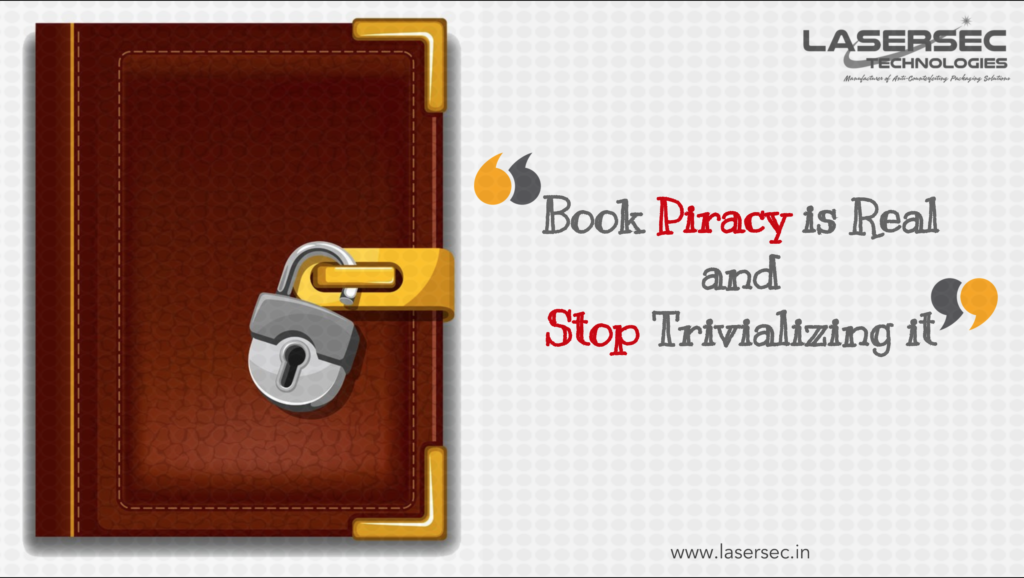
Book Piracy is Real and Stop Trivializing it !

Books are quintessential to say the very least and the source of wisdom and truth. Books are also written by humans and honestly being a writer is not that easy.

It takes a lot more than inspiration to churn out a compact book for the readers including the number of sleepless nights and little sacrifices that makes a book happen.

Humankind has this weird agenda of creating or rather cloning things that can be sold anywhere at any price, so piracy in the fields of the book is also prevalent in this sad existence. This has turned out to be a killjoy for most of the writers since privacy hits the writers very hard.

Book piracy is often trivialized, but the truth is that it exists. If one asks the very definition of book piracy, then a proper definition can be provided since the protocols/ideas of piracy are the same.

Reports suggest that about 70,000 books are being published by 15,000 publishers in 22 different languages from our country. In 2011, according to Have to scope India lost around 20 Million Indian Rupees which amounts to $387,000, because of book piracy.

Let us check out, how the Book Piracy works?

The piracy of books in India primarily depends on two factors, one the price and the other is its popularity. A study conducted under Indian Ministry of HRD suggested that print piracy which is prevalent in India is of three distinct types. The most prevalent one is reprinting of books illegally.

The second one is where they falsely use the name of authors, and the last type is where the pirated books are being sold which is the transalated version of any foreign author. The pirates do seem to pay taxes on the profit generated with respective revenues. But for this, the author gets no royalty fee for their book.

It doesn’t just end there; books are being photocopied extensively near the school, college, and universities. Book piracy is surviving longer than it was expected and has grown to be a very lucrative business which doesn’t end with the cloning of the texts but also the cover art, and even the holographic stickers and barcodes to baffle the reader with confusion.

The piracy impacts the author by denying their dues which hits the economic soft spots of any publisher too since a lot gets invested in bringing the copyrights.

The most alluring thing for the pirates is the textbooks since that is loot for them. The textbooks have a bulky demand because of its core importance as study material for school goers. It often so happens that the school reopens and the demand increases which often can’t be met by the combined forced of private and government publishers.

This is exactly where the pirates hop in. From certain sources, it has beeb discovered that March and April are where the bulk load of piracy happens. The original books are copied at presses, and the price comes to as low as ¼ of the original one. These books are of low quality and can easily be identified as a pirated copy. But with the advancement of technology, these books are now being sold keeping the quality in mind and can’t be distinguished. The small sellers often sell these books to meet the demands without caring much about the business ethics.

Reports suggest that the foreign publishers are also facing such issues where around 50billion pages are being illegally printed each year. Book Piracy is now easier due to the technological advancement where it just takes a printing machine and a scanner to reprint the books.

Academic books which are often very expensive get pirated for student’s convenience. These books are often circulated amongst the academic circuits, but mostly these books are photocopied. This menance of photocopying is not only affecting the industry but also jeopardizing the budding writers. Section 63 which is the copyright act of India, it is a criminal offense to sell or even buy photocopied books.

Despite the laws and the copyrights that protect the authors, this issue has been normalized and trivialized to some extent, but to address to this issue, the government body should implement a rigorous set of laws in they plan to combat this menance effectively.

Share :

Related Blogs

Export-Ready Pharma Packaging- What Global Buyers Are Now Expecting

You’ve secured the order, production is complete, and your shipment is ready to move. But then, just before dispatch, your buyer asks:

“Does your packaging meet serialization and scan-based proof requirements?”

Imagine losing a million-dollar contract — not because of your medicine, but because your packaging failed to inspire trust. This is the reality many exporters face today. For global buyers, packaging has become the deciding factor between smooth delivery and a deal falling apart.

Why Packaging Standards Are Now Non-Negotiable

Global buyers are under pressure from regulators, distributors, and patients. They must ensure every product they source is traceable, authentic, and tamper-proof. That means export-ready packaging is no longer optional — it’s the foundation of international trade.

Key compliance must-haves include:

  • Track & Trace Systems – complete product visibility across the supply chain
  • Serialization – unique identifiers that meet global compliance norms
  • Tamper-Evident Features – seals or packaging that immediately reveal interference
  • Scan-Based Proof – QR codes or secure markings enabling instant authentication

Without these, buyers see risk — and in today’s market, risk means rejection. It’s not just about checking compliance boxes. Buyers want reassurance that:

  • Their shipments won’t face customs delays due to packaging gaps
  • They won’t be caught in regulatory disputes in importing countries
  • They can confidently show stakeholders a secure supply chain
For exporters, this transforms packaging into a proof of credibility. It’s no longer just a container — it’s part of your business reputation.

Regional Buyer Expectations: One Size Doesn’t Fit All

Every region enforces its own regulations. Understanding them isn’t just smart — it’s survival.

RegionKey Packaging ExpectationsWhat It Means for Exporters
European Union (EU)Strict serialization under the FMD (Falsified Medicines Directive) with database-driven verification.Packs must be registered and verifiable via EU hub. Non-compliant shipments are rejected at borders.
United StatesDSCSA (Drug Supply Chain Security Act) requires interoperability and traceability beyond serialization.Exporters must ensure their systems “talk” with US buyers’ systems for seamless data exchange.
Middle East & AfricaHigh counterfeit risks demand visible tamper-evidence + secure scan codes.Buyers expect seals and markings they can verify instantly at distributor level.

According to the WHO, 1 in 10 medical products in low- and middle-income countries is substandard or falsified — highlighting why MEA and APAC buyers demand extra layers of security.

Before shipping, ask yourself:

  • Does every pack carry a unique, scannable serialization code?
  • Is there a tamper-evident seal that cannot be replaced unnoticed?
  • Can my systems generate and share serialization data with buyers?
  • Do I have scan-based proof of authenticity ready for customs or audits?

If the answer is “no” to any of these, your packaging isn’t truly export-ready.

Indian pharma is globally respected for high-quality medicines. But as regulations tighten, packaging standards are becoming the new benchmark for trust.

Those who adapt quickly — with serialization, secure QR codes, and tamper-evident solutions — will stand out as reliable partners. On the other hand, exporters who delay risk losing contracts, not because of product quality, but because their packaging didn’t pass the credibility test.

Global buyers are no longer asking if your packaging is compliant — they’re asking how quickly you can prove it.

Export-ready packaging is now a business advantage, not just a compliance step. For exporters preparing to expand globally, investing in the right packaging solutions is no longer optional.

Because in today’s market, packaging isn’t just protecting your product — it’s protecting your growth.

At Lasersec Technologies, we partner with pharma exporters to ensure their packaging meets global serialization, traceability, and anti-counterfeit standards — helping you ship with confidence and win global trust.

Holographic Blister Packaging for CDSCO Compliance

India’s pharmaceutical landscape is undergoing a transformation — and packaging is at the center of it.
With the CDSCO’s new QR code and serialization mandates, every exported pharma product must now be secure, traceable, and tamper-evident.

For manufacturers, especially SMEs, this can feel like a complex compliance challenge.
But there’s a powerful, proven solution already within reach: Holographic Blister Packaging.

1. The New CDSCO Reality

To curb counterfeit drugs and ensure authenticity across the supply chain, the Central Drugs Standard Control Organization (CDSCO) now requires export-bound pharmaceutical products to carry:

  • Secure and scannable QR codes
  • Unique serialization at batch or unit level
  • Tamper-evident features on primary packaging
This means your packaging must do more than look professional — it must communicate trust, security, and transparency to regulators, distributors, and patients worldwide.

2. Why Holographic Blister Packaging Foils Are the Ideal Fit

Holographic blister foils are designed not just for visual appeal, but for multi-layered protection.
They merge optical security, digital traceability, and physical tamper resistance — all in one compact, cost-effective solution.

Key advantages include:

  • Built-in Anti-Counterfeit Security:
    Complex holographic patterns, diffractive designs, and hidden laser effects make duplication nearly impossible.
  • Tamper-Evident Layering:
    Any attempt to peel or alter the foil leaves visible damage — ensuring that the product cannot be resealed or reused undetected.
  • QR & Serialization Integration:
    Holographic foils can seamlessly integrate dynamic QR codes and serialized data, allowing regulators and end-users to instantly verify product authenticity.
  • Regulatory Compliance:
    They fulfill the CDSCO’s core requirements — secure labeling, traceability, and anti-tampering — without requiring major production line changes.
  • Supply Chain Visibility:
    When linked to digital Track & Trace systems, each blister pack becomes part of a transparent, verifiable export network.

3. How It Works

Each holographic blister foil is embedded with security layers visible and invisible to the naked eye.

When printed with unique serial numbers or QR codes, it creates a dual-authentication system:

LayerFunctionBenefit
Optical Security (Holography)Visually identifiable design that’s impossible to replicateInstant brand and regulatory authentication
Digital Security (QR + Serialization)Unique, scannable identity for every packEnables verification and traceability
Tamper EvidenceIrreversible visual damage on interferencePrevents resealing or counterfeit replacement

This layered approach makes it extremely difficult for counterfeiters to reproduce or reuse packaging — offering compliance with confidence.

4. Why SMEs Should Choose Holographic Blister Packaging

Unlike large-scale digital upgrades, holographic blister foils are scalable, adaptable, and cost-efficient.
For SMEs, this means:

  • No heavy capital investment in new lines
  • Immediate enhancement of regulatory readiness
  • Compatibility with existing packaging formats
  • Added brand value in export markets
It’s a simple way to make your products CDSCO-compliant and globally credible — without the complexity of building new infrastructure.

5. Beyond Compliance: Building Trust Across Borders

The global pharma supply chain thrives on transparency.
By adopting holographic blister foils, Indian exporters not only meet CDSCO and international labeling mandates but also strengthen brand trust with distributors and healthcare professionals abroad.

  • Regulators see transparency.
  • Distributors see authenticity.
  • Patients see safety.

And your brand earns long-term credibility in every market it reaches.

Secure, Scalable, and Future-Ready

The CDSCO’s labeling mandates are here to stay — but compliance doesn’t have to be complicated.

Holographic blister foils bring together the best of physical and digital protection, offering a ready-to-implement, regulation-compliant, and cost-effective solution for Indian pharma exporters.

At Lasersec Technologies, we specialize in custom-designed holographic blister foils that combine optical security, dynamic QR codes, and tamper-evident protection.
Our solutions are trusted by leading pharmaceutical manufacturers to safeguard brands, meet regulatory standards, and ensure patient safety.

Let’s help you make compliance your competitive edge — one blister pack at a time.